


Nyansapo Award of the House of Obeng
By the authority of HRH Oheneba Nana Kwame Obeng II, Mimhene of Sefwi Obeng-Mim, there is established within the Royal House of Sefwi Obeng-Mim an honor known as The Wisdom Knot, or Nyansapo.
The Wisdom Knot is among the most limited personal honors of the Royal House. Membership is restricted to five living persons at any one time. It is bestowed upon those whose lives demonstrate exceptional wisdom, sound judgment, patience, ingenuity, and faithful service to community and humanity.
At present, two persons hold the Wisdom Knot, leaving three places unfilled. The limitation is intentional. The Wisdom Knot is not intended to become a large order or association, nor is membership granted simply in recognition of office, rank, generosity, or length of service. It recognizes a quality of character and wisdom demonstrated over time.
Nyansapo
The emblem of the honor is Nyansapo, the Akan "Wisdom Knot," one of the traditional Adinkra symbols of Ghana. Nyansapo represents wisdom, intelligence, ingenuity, patience, and the capacity to understand what is difficult.
The symbol is associated with the Akan proverb:
Nyansapo wosane no badwenma.
"A wise knot is untied only by the wise."
The proverb teaches that wisdom is more than the possession of knowledge. The wise person has the patience and discernment to understand complexity, to recognize what may be loosened and what must remain bound, and to find a way through problems that cannot be resolved by force alone.
For the Royal House of Sefwi Obeng-Mim, Nyansapo therefore represents wisdom exercised in service. Its recipient should be a person whose counsel brings understanding, whose judgment has been tested, and whose life demonstrates that intelligence without patience and responsibility is incomplete.
The Grand Collar
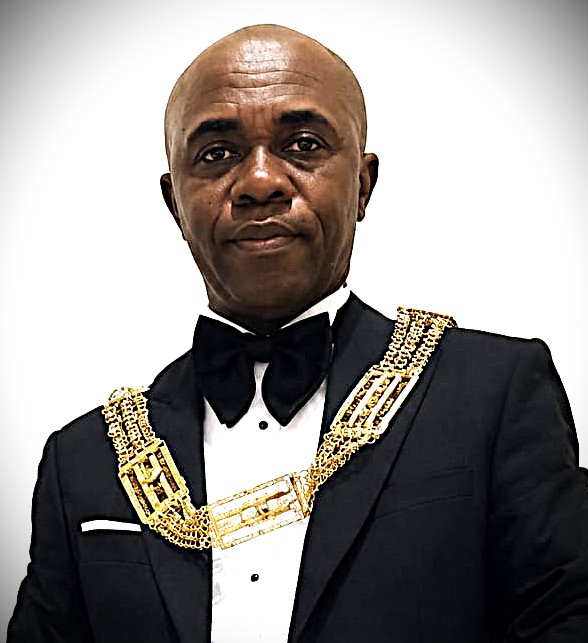
The insignia of the Wisdom Knot is a Grand Collar, individually made by hand by a member of the Royal Family of Sefwi Obeng-Mim.
The handmade character of the collar is essential to the honor. It is not merely a decoration manufactured and distributed in the name of the Royal House. Each collar is a work of the House itself and embodies a personal bond between its recipient, the Royal Family, and the Stool of Sefwi Obeng-Mim.
The central emblem of the Grand Collar is Nyansapo. Its design should draw upon the artistic traditions and visual language of Ghana and the Akan people, while allowing each handmade collar to possess the small distinctions naturally created by its maker. These distinctions are not imperfections. They testify that the collar was made by human hands and presented as an expression of relationship, respect, and trust.
No more than five Grand Collars of the Wisdom Knot may be held by living recipients at any time.
Membership
Admission to the Wisdom Knot is made solely by the Mimhene of Sefwi Obeng-Mim. It is a personal honor of the Royal House and is not obtained through application, nomination campaigns, donation, purchase, or automatic progression through another honor.
Membership is for life unless relinquished or withdrawn for grave cause.
Upon the death of a member, that place within the Wisdom Knot becomes vacant and may thereafter be bestowed upon another worthy person. The deceased member nevertheless remains permanently recorded in the historical register of recipients.
The Grand Collar itself is an heirloom of honor associated with the person upon whom it was bestowed. Upon the death of its recipient, it may remain with the recipient's family as a memorial of the relationship between that person and the Royal House, unless different arrangements were established at the time of bestowal. The collar does not confer membership, title, or privilege upon an heir.
Character of the Honor
The Wisdom Knot carries no rank of nobility, chieftaincy, hereditary dignity, or governmental authority. It is not a grade within the Royal Orders of the House and does not supersede customary Akan titles or offices.
Its distinction rests instead upon its rarity.
Only five living people may bear the Wisdom Knot. They are joined not as members of an organization requiring meetings or administration, but as persons whom the Royal House has recognized as possessing the wisdom represented by Nyansapo.
The honor therefore recalls an ancient truth preserved in the Akan proverb: some knots cannot be cut without destroying what they bind. They must be understood.
And only the wise know how to untie them.